The 5 Best Simple Analytics Tools for Your Website (Compared)
If you searched for simple analytics or simple web analytics, you already know what you do not want: Google Analytics. You want traffic, sources, and top pages in one screen, without cookies, consent banners, or a two-hour setup.
That is a narrower job than most analytics products admit. GA4 can do it, but only after you learn events, explorations, and a report builder. Mixpanel and Amplitude can do it too, if you enjoy configuring them. For most sites, that is the wrong starting point.
After using the privacy-first options side by side, five tools actually stay simple in daily use: Seline, Fathom, Simple Analytics, Plausible, and Umami. All five are cookieless. All five skip the banner for standard tracking. They differ on price, live data, self-hosting, and how far you can go past pageviews.
TL;DR: which simple analytics tool to pick
- Seline — Best default. One plan from $9/month, cookieless, real-time, with funnels, journeys, and revenue included if you need them later.
- Fathom — Best if you want the smallest possible dashboard and forever data retention. From $15/month for 100k pageviews and 50 sites.
- Simple Analytics — Best if you want the namesake product: EU-hosted, no fingerprints, a live dashboard, a free hobby plan, paid from $20/month.
- Plausible — Best open-source cloud option. From $9/month, or self-host the Community Edition.
- Umami — Best free path. Self-host at $0, or use Cloud Hobby at 100k events/month.
The rest of this guide compares them on pricing, cookie-free tracking, real-time data, self-hosting, and free tiers, then unpacks each tool.
Quick comparison: 5 simple analytics tools
| Tool | Pricing | Cookie-free | Real-time | Self-hosted | Free tier |
|---|---|---|---|---|---|
| Seline | From $9/mo | Yes | Yes | No | 7-day trial |
| Fathom | From $15/mo | Yes | Yes | No | 7-day trial |
| Simple Analytics | From $20/mo | Yes | Yes | No | Yes (hobby) |
| Plausible | From $9/mo | Yes | Yes | Yes | 30-day trial / self-host |
| Umami | Free, or Cloud from $0 | Yes | Yes | Yes | Yes (Hobby + self-host) |
Prices are public list prices as of September 2026, billed monthly at each product's entry tier. Seline and Plausible start at 10k monthly events/pageviews. Fathom and Simple Analytics start at 100k. Umami Cloud Hobby includes 100k events. "Free tier" means a plan you can keep using at $0, not a trial. All five include a live dashboard.
What simple web analytics should actually do
A simple web analytics tool earns a place on this list if you can install it in a few minutes and answer four questions the same day:
- Where did this traffic come from?
- Which pages got it?
- Did anyone convert?
- Can I show this to a client or cofounder without explaining the UI?
That is it. Demographics, pathing models, and 40 default reports are optional. If you later need journeys, funnels, or revenue, the tool should add them without a second product.
Four other checks matter in 2026:
No cookies for basic tracking. If the script needs a banner, you will lose a chunk of visits to the "reject" click. All five tools here are cookieless for standard pageviews. See our cookieless analytics guide if you want the legal and measurement background.
A dashboard you will open. If the home screen is a blank canvas, you will not use it. Simple tools put visitors, sources, pages, and campaigns on one page.
Honest pricing. Traffic-based plans are fine. Feature gates that hide funnels behind a higher tier are how "simple" products stop being simple.
Cloud vs self-host. Self-hosting is cheaper on paper and more work in practice. Pick it when data residency or $0 license cost is the point. Pick cloud when you want someone else to keep the lights on.
GA4 fails several of these at once. It is free, powerful, and hard to run under GDPR. If that is why you are here, start with the five below. For a wider field, see Google Analytics alternatives.
Entry prices are not comparable at the same traffic. Seline and Plausible advertise $9 because their first paid rung is 10k events. Fathom and Simple Analytics advertise $15 and $20 because their first paid rung is 100k pageviews. At 100k events Seline is $24. At 10k pageviews Fathom still costs $15. Pick the column that matches your volume, not the homepage number.
Moving from Google Analytics
You do not have to rip GA4 out on day one. The usual path:
- Keep GA4 running.
- Add one cookieless script from this list.
- Compare a week of pageviews and top sources. Expect a gap. Banners, ad blockers, and consent mode all suppress GA4. The new number is often closer to "people who actually loaded the page."
- Recreate only the conversions you use: signup, purchase, newsletter. Ignore the 30 GA4 events nobody has opened since the migration.
- Remove GA4 when the new dashboard is the one you check in the morning.
None of these five tools is a warehouse. If you need BigQuery exports, user-ID stitching across apps, and Google Ads audience sync, stay on GA4 (or add a cookieless tool beside it). Simple Analytics even sells that "data layer next to GA4" motion on their enterprise page. For everyone else, parallel tracking for two weeks is enough.
Historical GA data rarely comes across cleanly. Fathom and Plausible offer a GA import. Treat it as a bonus, not a reason to pick the tool. Your useful history starts at install.
1. Seline
Seline is the simple web analytics tool I would install first on a new site.
You add one script, open the dashboard, and get traffic, referrers, top pages, and UTMs. No property wizard, no event schema homework, no "explore" tab. If all you wanted was a cleaner GA4, you can stop there.
The difference vs the other four is what happens when you outgrow pageviews. Funnels, visitor journeys, AI filtering, and Stripe/Polar revenue sit on the same plan. You do not migrate to Mixpanel later, and you do not pay Plausible Business prices to unlock the extra reports.
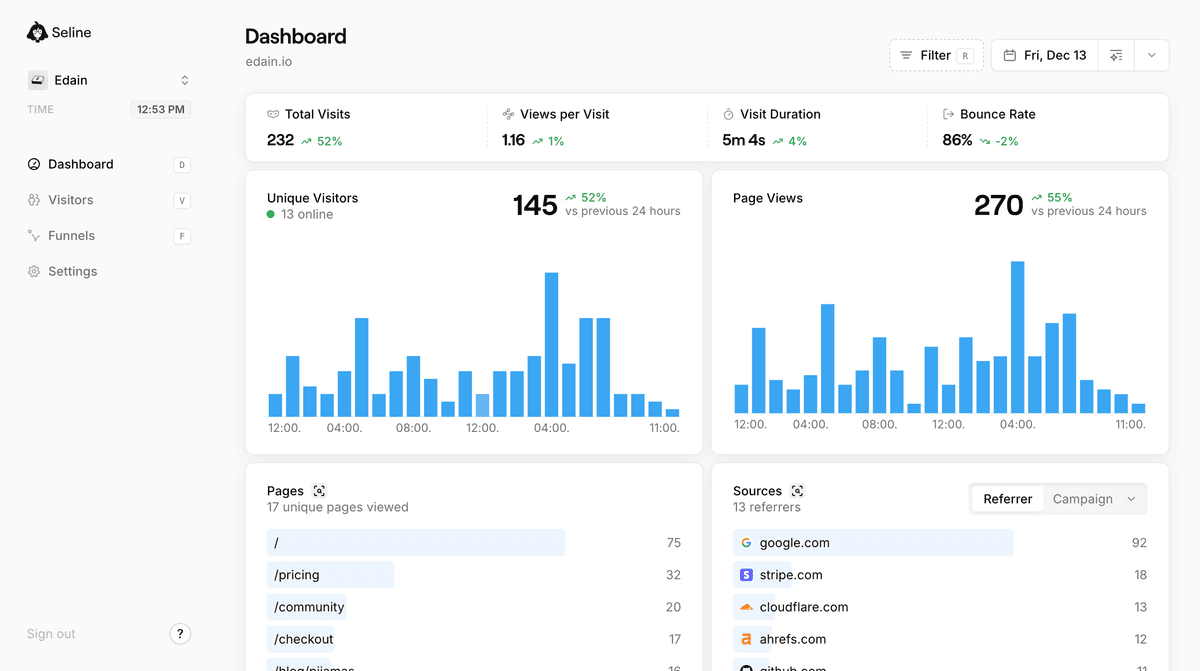
Seline is cookieless by default and built for GDPR, PECR, and CCPA. Data lives in the EU. The script is about 2 KB, so it will not be the thing that slows your LCP.
Seline key features
- One-page traffic dashboard with visitors, pageviews, sources, entry/exit pages, devices, and countries.
- Real-time live view, including a live globe, so launches and campaigns are visible as they happen.
- UTM and campaign tracking without a separate report builder.
- Custom events for sign-ups, clicks, and other actions that are not pageviews.
- Funnel analysis for multi-step flows, included rather than gated.
- Visitor journeys and profiles for logged-in or identified users: path, drop-off, and what they did before converting.
- Revenue analytics via Stripe, Polar, or custom revenue events, so you can see which channels actually pay.
- AI filtering in plain English ("visitors from the US in January") instead of stacked dropdowns.
- Ad-blocker bypass by routing the script through your own subdomain.
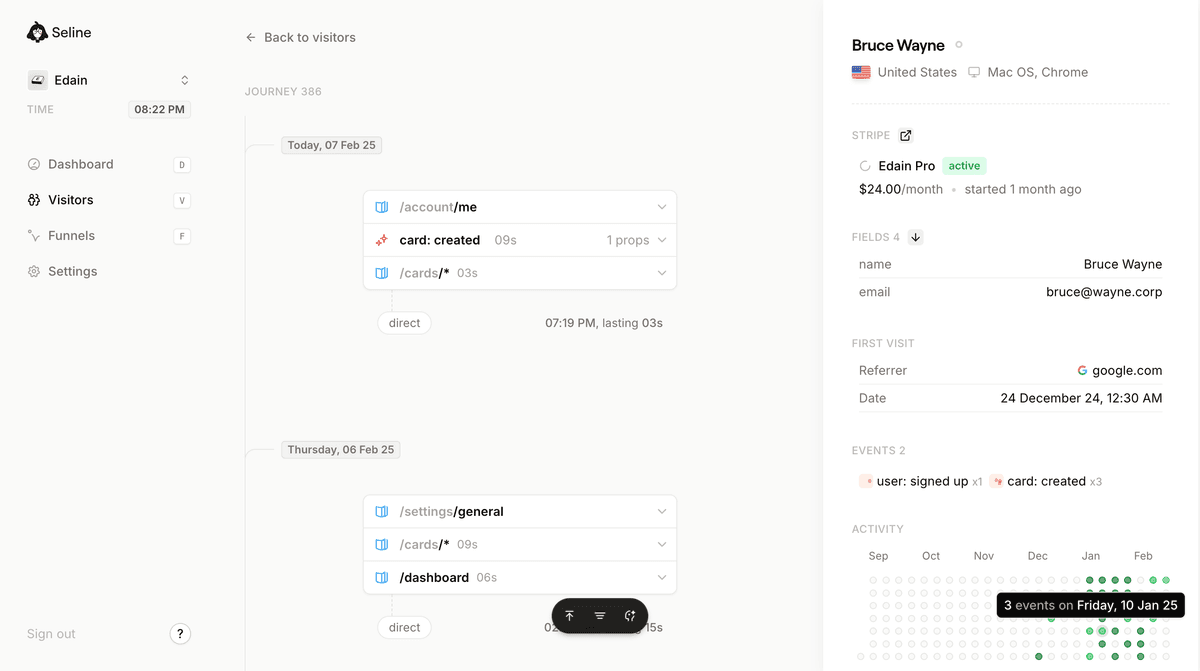
You can ignore journeys and revenue forever. They are there so "simple" does not mean "dead end."
Setup is one script tag. Most sites are live in a few minutes. If you want events, you send them from your app or tag manager the same way you would anywhere else. Connecting Stripe is optional and takes a settings page, not a developer project.
A normal week in Seline looks like this: Monday you check which posts and campaigns moved. Midweek you filter a country or a UTM in the AI box instead of building a segment. On launch day you leave the live view open. If a signup funnel is leaking, you open that funnel rather than exporting CSV into a spreadsheet.
Seline pricing
Seline pricing is one Pro plan. Every feature is included. You pay for monthly pageviews plus custom events.
- From $9/month at 10,000 events
- $14/month at 25,000
- $24/month at 100,000
- Yearly billing knocks off two months
- 7-day trial, no credit card
- Forever data retention
- Unlimited websites, with the option to share one event quota across linked sites
There is no permanent free cloud plan. There is also no "Business" tier that unlocks funnels. Compared with Plausible, that matters once you want conversion reporting: Plausible keeps funnels, journeys, and ecommerce on Business (from $19/month at 10k pageviews). Compared with Fathom, Seline is cheaper to start and more expensive at 100k if you only need a traffic dashboard. You are paying for the extra product surface.
Seline best for
Site owners, indie SaaS, and small teams who want simple web analytics on day one and conversion context later, without running two tools. Also a strong fit if you already bill through Stripe or Polar.
Skip Seline if you must self-host, or if you need a $0 plan after the trial. In those cases Umami or Simple Analytics hobby are the honest answers. Skip it if you only manage 40 client blogs and never look at conversions; Fathom's 50-site entry plan will be cheaper at 100k combined pageviews.
Seline pros and cons
Pros
- Fastest day-to-day dashboard in this list
- Cookieless, EU-hosted, real-time
- Funnels, journeys, AI, and revenue on the entry plan
- Unlimited websites on one subscription
- Custom-domain bypass for ad blockers
Cons
- No self-hosted edition
- No forever-free cloud plan
- At 100k events, a traffic-only tool like Fathom can be cheaper
Get started with web analytics for free.
Sign up for Seline now - no credit card required. Cookieless, privacy-friendly, independent.
Get started
2. Fathom Analytics
Fathom is what people mean when they say they want "just the numbers." It is an independent, privacy-first dashboard you understand in one sitting.
If GA4 feels like a cockpit, Fathom is a speedometer. Pageviews, referrers, campaigns, events, and a live count of who is on the site right now. That is the product.
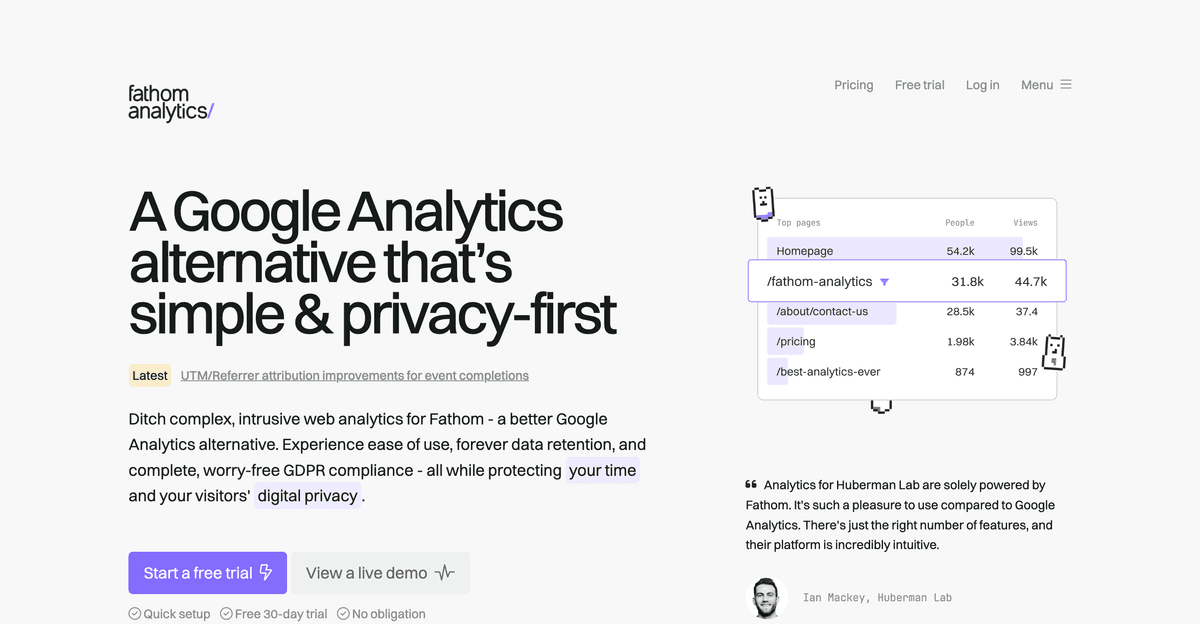
Fathom is cookieless, so you typically skip analytics consent banners. It is built to comply with GDPR, CCPA, ePrivacy, and PECR. The tracking script is about 2 KB. Bots and scrapers are filtered so you are closer to human traffic.
It does not try to be a product analytics suite. No visitor profiles, no journey maps, no AI chat. For a content site or a marketing site that only needs traffic + campaigns, that restraint is the point. For a longer Fathom vs GA4 write-up, see our Fathom guide. Side by side with Seline: Fathom vs Seline.
Install is one line of script on any CMS or framework. Shared dashboards are the agency feature: give a client a passworded URL instead of a seat. Email reports cover the "I never log in" stakeholder. Forever retention is the SEO/content feature: year-over-year comparisons without exporting to Sheets because your retention window expired.
Fathom key features
- Real-time dashboard with current visitors and core traffic metrics
- Up to 50 sites on the entry plan, more on larger pageview tiers
- Forever data retention while you are a customer, which is rare in this category
- Custom events and ecommerce on every plan, counted toward pageviews
- UTM campaign tracking
- Shared and password-protected dashboards for clients
- API access (600 requests/hour on published plans)
- Email reports and CSV exports
- GA import if you are leaving Google Analytics
- No cookie banner required for standard tracking
There is a legacy open-source project called Fathom Lite. It is a different product: it uses cookies, it is in maintenance mode, and it lacks the current SaaS feature set. Treat current Fathom as cloud-only.
Fathom pricing
Fathom pricing is a pageview slider, not named feature tiers. Pricing starts at $15/month.
- $15/month for 100,000 pageviews, 50 sites included
- Higher tiers are a pageview slider, not feature gates
- Annual billing is two months free ($150/year at the entry tier)
- Extra sites in packs of 50 for $10/month
- 7-day free trial, no long-term contract
- No permanent free plan
Custom events count as pageviews. If you go over your limit for two months in a row, Fathom asks you to upgrade rather than cutting collection on the first spike.
For agencies, 50 sites at $15 is the deal. For a single 8k-pageview blog, you are paying for headroom you may not use. Plausible or Seline start lower for that case.
Fathom best for
Publishers, agencies, and marketing sites that want a tiny, trusted traffic dashboard, lots of sites on one bill, and year-over-year data that never expires. Skip it if you need user-level journeys or a free plan.
Fathom pros and cons
Pros
- Genuinely small UI, real-time, cookieless
- 50 sites on the cheapest plan
- Forever retention
- Events and ecommerce included, not add-ons
- Predictable overage behavior
Cons
- No free tier
- Entry price assumes 100k pageviews
- No self-host for the current product
- No visitor journeys, funnels, or revenue attribution in the Seline sense
- Short trial if you need to judge seasonal traffic
3. Simple Analytics
Simple Analytics is both a search query and a company. If you typed the brand name, this is the product. If you typed the category, it is one of five, not the only answer.
The Netherlands-based team built a cookieless, no-fingerprint analytics layer: no cookies, no IP storage, no visitor IDs. Data stays in the EU. The pitch is a one-page live dashboard plus an AI chat, so you ask for a number instead of assembling a report.
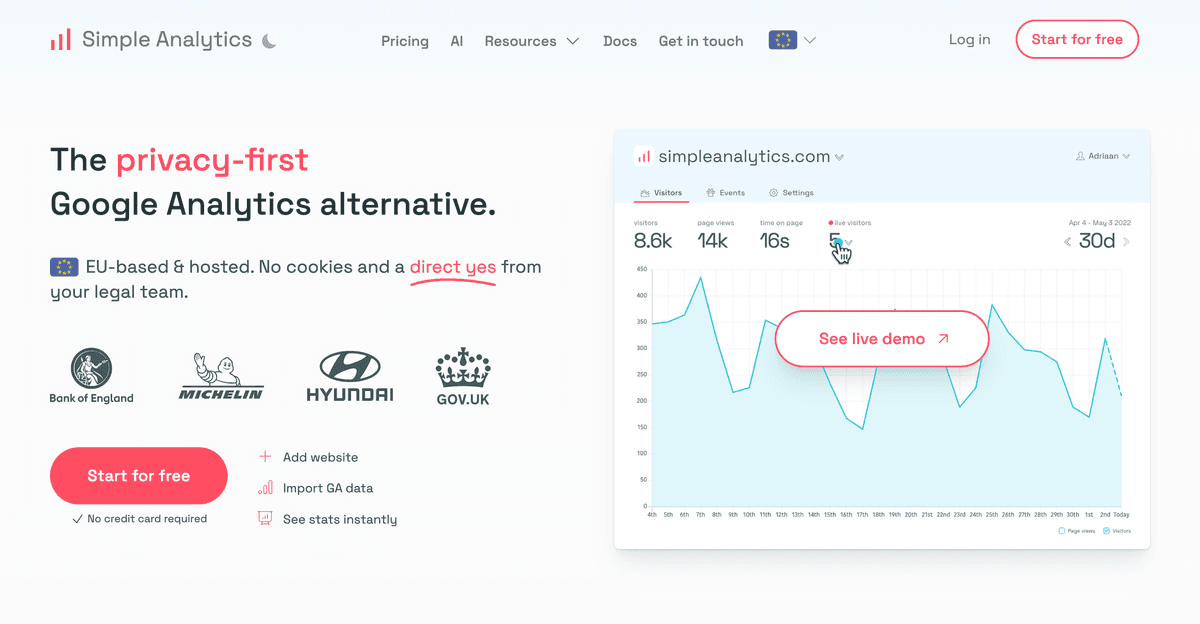
That privacy stance is stricter than most peers. Unique visitors are estimated from landing-page views, not tracked across sessions. You get coverage without a consent wall, and you give up person-level paths. The dashboard itself is live: you can watch traffic as it comes in.
If you want the same privacy defaults plus journeys and revenue, we compared the two products in Seline vs Simple Analytics.
Simple Analytics also positions itself as a cookieless baseline next to GA4: you keep Google for ads and explorations, and you keep Simple Analytics for the visits consent mode never saw. That is a real use case. It is a weaker use case if you were trying to replace GA4 with one dashboard. For a replacement, you still need events, campaigns, and a conversion story. Simple Analytics will do goals. It will not do person-level paths.
Simple Analytics key features
- Live one-page dashboard for pageviews, referrers, campaigns, and current traffic
- No cookies, no fingerprinting, no stored IPs
- EU hosting (Netherlands); data is not resold
- Goals, events, and UTM tracking
- AI chat for questions you would otherwise build a report for
- Public stats pages if you want to publish traffic
- API / JSON export from dashboard URLs
- 14-day full-feature trial, then paid or free hobby
It is not a product analytics tool. No funnels, no session replay, no identified users.
Simple Analytics pricing
Published self-serve pricing:
- Paid self-serve: $20/month at 100,000 pageviews, 1 user included
- Extra users: +$20/month each
- Annual: two months free
- Free hobby plan: 1 user, 5 websites, 30 days of history, badge required, unlimited pageviews under fair use
- 14-day trial, no credit card
- Traffic billing follows usage (recent month, then a 3-month average)
- Enterprise is a separate "data layer" product (SSO, SOC 2, warehouse export), quoted
The free plan is real, which Fathom and Seline do not offer. The paid plan is the most expensive entry in this list at 100k pageviews, and per-seat pricing adds up for a team. There is no self-hosted edition.
Simple Analytics best for
Privacy-maximal teams, EU organizations, and hobby sites that will live with a badge and 30-day history. Also a fit if you want to run cookieless analytics next to GA4 as a complete-traffic baseline.
Skip it if your team is more than one person and you are paying seats. Skip it if you expected Mixpanel-style people reports from a product named "Simple." The name is accurate. The depth stops at aggregate traffic.
Simple Analytics pros and cons
Pros
- Strongest "collect nothing personal" stance in this list
- Live dashboard
- Real free plan for small sites
- EU-only by default
- AI chat on a minimal dashboard
- 14-day trial of the paid product
Cons
- $20/month entry, plus $20 per extra user
- No self-hosting
- No journeys, funnels, or revenue attribution
- Free plan shows a badge and drops history after 30 days
4. Plausible Analytics
Plausible is the open-source default in simple web analytics. Independent, EU-hosted (Hetzner in Germany), funded only by subscriptions. The cloud app and the Community Edition share the same privacy model: no cookies, no personal data, no banner for standard tracking.
The dashboard is one screen: sources, pages, locations, devices, goals, and real-time. The official script is under 1 KB, the smallest in this list.
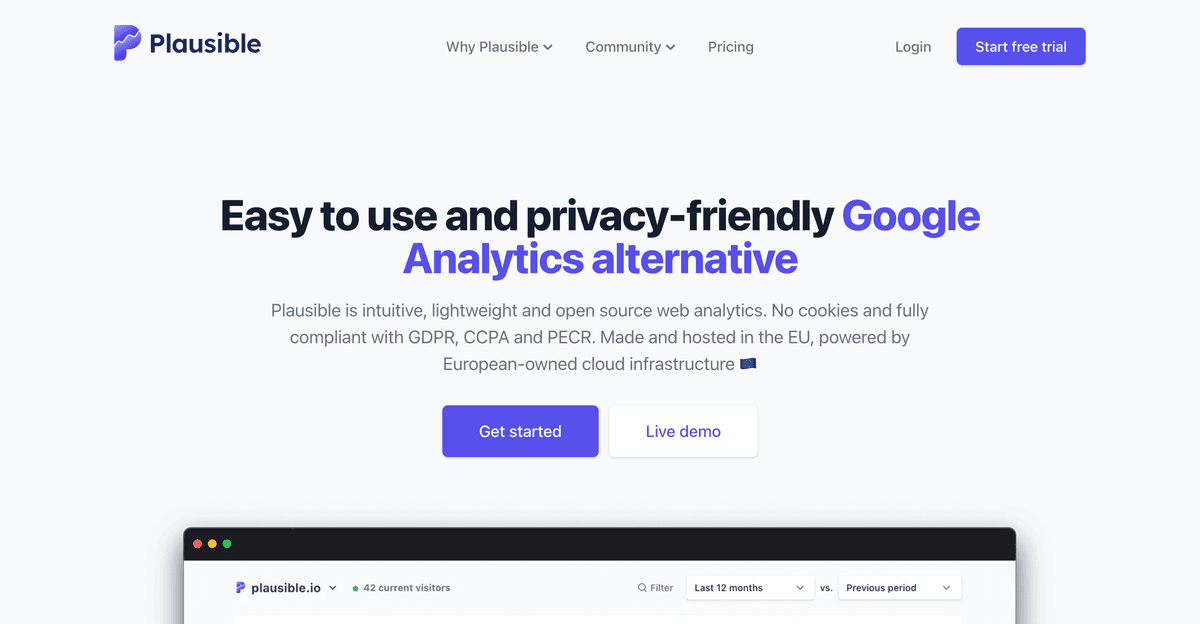
The code is public. That is the trust feature. It is also why Plausible splits cloud vs CE: funnels, ecommerce revenue, SSO, and the sites API stay on paid cloud so the project can keep shipping.
For the full price ladder, see Plausible Analytics pricing.
Plausible key features
- Cookieless, aggregated analytics with a daily-rotating visitor hash
- Real-time traffic on the main dashboard
- Goals and custom events (events count toward usage; pageview goals do not)
- UTM campaigns, outbound links, file downloads, 404s
- Google Analytics import
- Shared dashboards and embeds on Growth+
- Funnels, user journeys, ecommerce revenue, Stats API, Looker Studio on Business
- Self-host Plausible CE (AGPL) if you want $0 license cost
- 30-day cloud trial with Business features enabled so you can test the top tier
Self-hosting CE means you run Postgres, ClickHouse, and the app. You also go without those Business-only features. That is a fair trade if ownership is the goal. It is a poor trade if you wanted a five-minute install.
The decision that actually bites is Starter vs Business, not Starter vs Fathom. Starter is enough for a personal site that only needs "did the post get traffic." The moment you want a signup funnel or revenue on a checkout thank-you page, you are shopping Business, and the monthly number is no longer $9. Seline puts those reports on $9. That is the comparison to make, not "both start at nine dollars."
Plausible pricing
All paid plans share the same pageview tiers. You pick Starter, Growth, or Business for features.
At around 10,000 monthly pageviews:
- Starter: $9/month — 1 site, core dashboard, goals, 3 years retention
- Growth: $14/month — up to 3 sites and 3 team members, shared dashboards
- Business: $19/month — funnels, journeys, ecommerce, API, 5 years retention
- Enterprise: custom (SSO, Sites API, managed proxy, raw exports)
- No free cloud plan
- 30-day trial, no credit card
- Yearly billing saves two months
- Usage = pageviews + custom events across the team
A single month over the limit does not force an upgrade. Two consecutive months does. Self-hosted CE is $0 to Plausible; you pay the VPS, backups, and your time.
Starter at $9 is the cheapest paid entry here, but it is one site and no funnels. The moment you want conversion reporting, you are on Business, and the "simple $9 tool" is a $19+ tool.
Plausible best for
Teams that want open-source transparency, a tiny script, and either a cheap one-site cloud plan or a self-hosted stack they will actually maintain. Developers and privacy-conscious blogs are the core audience.
Plausible pros and cons
Pros
- Open source, inspectable, self-hostable
- Smallest script, real-time, cookieless
- $9 Starter is the lowest paid entry
- 30-day trial with Business features
- EU hosting, no VC pressure
Cons
- Funnels, journeys, and revenue are Business-only
- Starter is one site
- No permanent free cloud plan
- CE self-host needs ClickHouse and ongoing ops
- Cloud feature split is more complex than Seline's one plan
5. Umami Analytics
Umami is the simple analytics tool you run yourself. MIT-licensed, usually Docker + Postgres or MySQL, dashboard up in about ten minutes if you already have a VPS.
That is why developers move to it from Plausible CE: less infrastructure. Plausible wants ClickHouse. Umami is happy on a small Postgres box.
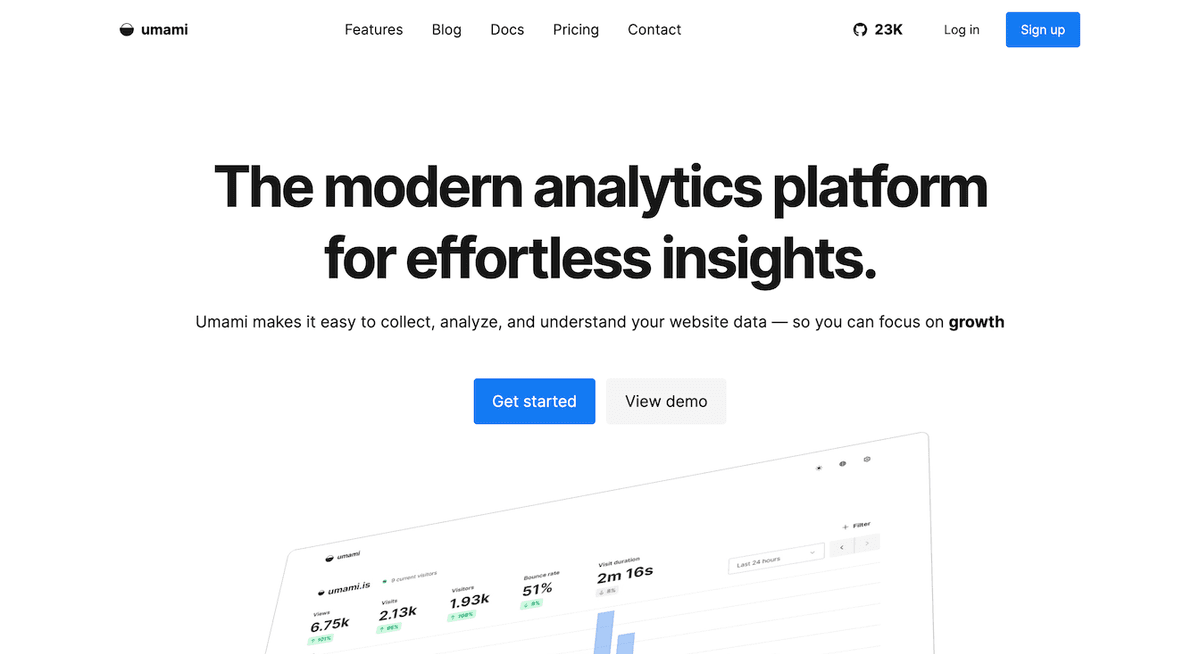
Umami is cookieless and has a real-time view (last ~30 minutes of activity, plus active visitors). Ad blockers are less of a problem when the script is first-party on your domain.
The product line split in 2026: self-hosted OSS is still the lightweight traffic tool most people mean by "Umami." Umami Cloud adds a free Hobby plan and, on Business, extras like session replays and heatmaps. Do not assume every Cloud screenshot exists in the GitHub image you deploy.
Umami key features
- Self-host for free (MIT), or use Umami Cloud
- Cookieless pageviews, events, referrers, devices, countries
- Real-time dashboard and realtime API
- UTM / campaign tracking
- Multi-site on one instance (self-host) or up to plan limits (Cloud)
- API on paid Cloud; available on self-host if you run it
- Cloud Business extras: session replays, heatmaps, white-label, streaming API
- No cookie banner for standard tracking
Older reviews said Umami had no funnels. Cloud has been expanding into behavior and conversion reports. Confirm the feature on the plan you will actually use. Self-host users should treat core traffic + events as the reliable set.
Self-host setup is the usual Docker compose story: database, app, reverse proxy, backups, updates. If that sentence made you tired, pay for Cloud Hobby or pick a hosted tool. If you already run Postgres for the product, Umami is a small extra process and that is the whole appeal.
Hobby Cloud is the right free hosted option for one site under 100k events. The 6-month retention is the hidden cost. You will not do a year-over-year SEO review on Hobby. Fathom will. Seline will. Upgrade or self-host before you need that chart.
Umami pricing
Published Cloud pricing:
- Self-hosted: $0 license. You pay the server.
- Hobby: $0/month — 100k events, 1 website, 6 months retention, community support
- Pro: $20/month — 1M events included ($0.00003 per extra event), 20 websites, 10 team members, 2 years retention, API, email support
- Business: $200/month — 10M events, unlimited sites, replays, heatmaps, 5 years retention
- Enterprise: custom (SSO, SLA, invoices)
- Paid Cloud plans: 14-day trial
Hobby is a genuine free cloud tier, unlike Seline, Fathom, and Plausible. The 1-site / 6-month cap is the trade. Pro at $20 for 1M events is generous on volume; you are still on a simpler reporting model than Seline unless you pay for Business.
Umami best for
Developers, hobby projects, and teams that want data on their own hardware. Also the right pick if $0 is a hard requirement and you can keep a Docker compose file alive. Not the pick if you want a polished, fully hosted conversion suite on day one.
Umami pros and cons
Pros
- Free self-host and a real Cloud Hobby plan
- Light server footprint vs Plausible CE
- Cookieless, real-time, first-party friendly
- MIT license
- Cloud path if you outgrow ops
Cons
- You are the SRE on self-host
- Hobby is 1 site and 6 months of data
- UI is less polished than Seline or Fathom
- Advanced Cloud features sit on a $200/month plan
- Support on Hobby is community-only
How to choose a simple analytics tool
Use the constraint you cannot drop:
I want the default for a business site. Start with Seline. You get simple web analytics immediately, and you do not outgrow the plan when you add a signup funnel or Stripe.
I manage lots of sites and only need traffic. Fathom. Fifty properties at $15/month is the agency math.
I searched for the brand Simple Analytics, or I need a free badge-friendly plan. Simple Analytics. Keep the privacy model in mind: no people, estimated uniques.
I need open source and I will pay for cloud. Plausible Starter if one site is enough. Business if you need funnels.
I need $0 and I can host. Umami self-host. Plausible CE if you already like Plausible's UI and accept ClickHouse.
I need $0 and I will not host. Umami Cloud Hobby or Simple Analytics hobby. Both cap history. Neither is a full replacement for a paid dashboard on a growing product.
I am an agency billing clients for reporting. Fathom shared dashboards, or Seline with linked sites if those clients also care about funnels.
I run a SaaS with Stripe. Seline. Traffic without revenue is a vanity dashboard for a paid product.
I publish one blog and check stats twice a month. Plausible Starter or Umami Hobby. Do not overbuy.
If you are leaving GA4 and you are unsure, run your current tool and one of these in parallel for two weeks. Compare pageviews, not vanity. Then delete the one you stopped opening.
Frequently asked questions
What is simple web analytics?
Simple web analytics is traffic reporting without GA4's setup cost: visitors, sources, pages, and basic conversions, usually without cookies. You should be able to install a script and read a useful dashboard the same day. The five tools above are built for that job.
What is the best simple analytics tool in 2026?
For most paid sites, Seline. It stays as easy as Plausible or Fathom on the home screen, and it does not hide funnels or revenue behind a higher tier. Fathom wins if you only want traffic and many sites. Umami wins if the budget is $0 and you will self-host.
Is Simple Analytics the same as "simple analytics"?
No. Simple Analytics is a specific EU company. "Simple analytics" is the category. People use the same words for both, which is why this page covers the product and four alternatives that do the same job.
Do these tools need a cookie banner?
For standard cookieless pageview tracking, generally no, which is the main reason teams switch from GA4. Your lawyer still owns the final call for your jurisdiction and for any extra identifiers you add yourself.
Which simple analytics tools are free?
Umami self-host, Umami Cloud Hobby, and Simple Analytics hobby are free to keep using. Plausible CE is free to license if you host it. Seline, Fathom, and Plausible Cloud are paid after a trial (7, 7, and 30 days).
Can I self-host simple web analytics?
Yes: Plausible Community Edition and Umami. Seline, Fathom (current product), and Simple Analytics are cloud-only. Fathom Lite exists on GitHub but is not the current Fathom product.
Which tool has real-time data?
All five. Seline, Fathom, Simple Analytics, Plausible, and Umami each include a live dashboard.
Simple Analytics vs Plausible vs Fathom: which is simpler?
All three dashboards are one page. Fathom is the most reduced: traffic, campaigns, events, live count. Plausible adds goals and, on Business, funnels. Simple Analytics adds AI chat and a stricter "no identifiers" model. "Simplest UI" is Fathom. "Simplest privacy model" is Simple Analytics. "Simplest path to conversions" is Seline, then Plausible Business.
Will my pageview counts match Google Analytics?
No, and they should not. GA4 drops or models visits behind consent, uses a different session definition, and is blocked more often. Cookieless tools usually report more pageviews and fewer "users." Compare trends week over week inside one tool. Do not chase GA4 parity.
How long does it take to set up simple web analytics?
Cloud tools: minutes. Paste a script, confirm the first pageview, done. Events and revenue take longer because they live in your product, not in the analytics UI. Self-hosted Umami or Plausible CE: budget an afternoon the first time, then occasional updates.
Simple analytics, without the leftover complexity
You do not need 200 reports. You need to know who showed up, where they came from, and whether they did the thing that pays for the site.
Seline, Fathom, Simple Analytics, Plausible, and Umami all get you there without cookies. Pick Fathom or Plausible if the dashboard should stay tiny. Pick Umami or Plausible CE if the data should sit on your server. Pick Simple Analytics if the brand and the EU/no-fingerprint model are the point.
If you want simple web analytics that still has a next step (funnels, journeys, revenue) on the same bill, start a Seline trial. Seven days, no credit card, script in one tag.